First published on October 20, 2013, this one is not as popular as its prequel---(click here to read), but it is pretty popular still......
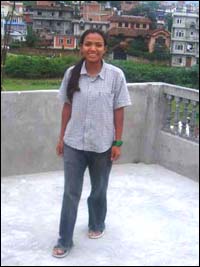
A young Nepali girl wearing green bangles. Green is the color of auspiciousness
A brief writing about the last post. I have been busy. But I also wanted two continuous posts about bangles. Just one post was not enough to illustrate the place of bangles in south asia.
Even when I was writing the post, I knew that there was too much information in too many directions. The post was bound to be a bit disorganized. But I simply wanted to put it all together. If I had more time the post would be better organized.
So, apologies about the lack of clarity or a common strain in the various aspects covered in the last story. Except that one solitary focus on bangles.
Often due to lack of time, my work on blogs is sporadic. This post alone has been worked on numerous times, and I must publish it before it blocks my day work. This is less than satisfactory for me, but I hope the readers will pardon me this time.
At times I am glad I am not doing this professionally. But I won't deny that the little readership I have, makes me feel connected to the cloud of people out there.
Out there, someone is waiting to read what I have to say. I can see that people are reading the blog, but it would be nice to get some comments back occasionally (not a hint or a request, just an observation, after all I do not write about controversial topics that generates heated debates.). But occasionally I do want to know that my comments are hitting home or making sense to the readers, or evoking some feelings.
Continuing on from the last post, there are a few things I still wanted to elaborate on with regards bangles. Please note that there are several links in this post, for all those who are interested in looking at appropriate images and reading more about various kind of art work. You will understand what I mean by diversity in Indian art.
Ingenuity of Indian Art:
In all my travels no place matches the art and intricacy and diversity of art available in India. (Alright, so I am biased, but there is truly something special about India, which is a sub-continent, a civilization and not a country). When I was in Fiji I saw much basket-work, or work on Tapa (a fabric created by beating coconut bark) --in Botswana it was both basket work and beadwork, Sweden has much embroidery and woodwork. All these forms of art are practiced in India, only, in an even more detailed fashion. I considered purchasing large Fijian mats that were used instead of carpets. Made of straw and palm leaves the mats were lightweight and cool on the body, at the same time providing a protection from direct heat (outdoors) or cold (indoors) of the ground. And wouldn't know you it, that I saw the same mats being sold in central Delhi, only they were made by Indians.
The same goes about bangles. While there is much art found in jewelry around the world, the generational knowledge (and research) focusing on one art is possible only in India. This requires a separate post, but caste system that is usually denounced around the world had many plus points. It must be denounced in the form it exists today and how it resulted in after degeneration of the society.
The exquisiteness of Indian art can no doubt be credited to generational work on one specific art form, which was a result of caste divisions. Th blacksmiths worked with iron, gold smiths in gold, and leather in leather. For generations, and so knew their material, as they know family. They knew the heat it could withstand, how to wet it and soak it, how to mold it, and when the material will get testy and not respond to the artisan. And how then, just like a family member must we work with the material --so that it may comply. That form of understanding your material and art was not about going to art school and then charging a thousand bucks for a piece of art that was not just abstract but also probably not of any use. A separate post is required to make clear what was the reason behind caste system. Having said that, divisions based on birth are not acceptable. But it must be borne in mind, that the highest caste in India, was also the poorest. Brahmins never had money, but they were rich in the mind--the knowledge bearers of a society. Not the same as in western class system, which was based completely in economics.
Back to bangles: The art of making bangles, with regards to the material used or the embellishments used varies from state to state (region to region--since state is a new word). Artisans used what was available and studied the material. For example, the last post talks about 'lac' and how it is prepared to create a certain kind of substance that can then be used to form jewelry.
One personal story that I remember is from when I lived in Delhi. Delhi, being the capital city, also showcases national art, both in museums and emporiums. While Museums are for the composite knowledge on display emporiums are where art is showcased to be sold. You can spend days just browsing through the emporiums in central Delhi. There are nearly thirty of these emporiums dedicated to every state and sometimes special skill, e.g. handloom industry. Khadi Gram Udyog--(cottage industry--focusing on handmade art from natural materials)--has an emporium that sells everything from sarees, to loose fabric, to embroidered fabric to handmade paper to, jewelry all made by hand, but using only natural fibers. I loved their papers made of silk and wheat husk. Now, they have also started a make-up line.
There were a few artisans who would set a deal with the emporiums and provide customized services privately at the showrooms. For example, one woman would say, I know how to embroider and can provide the customers would a personalized service. Another artisan would do the same with jewelry. So, when we were young girls we would go to Rajasthan emporium, the state famous for 'lac' jewelry, with our outfits, tell the artisan sitting outside there...'Bhiyaaji (dear brother) would you please make us earrings that match this color'. Sure he would nod humbly and tell us to collect that in a few hours.
Yes, a few hours!! And there we would have earrings and bangles matching to our outfits, right length, right size and right color. I have not seen that in a while, so I am assuming that aspect of personalized service does not continue anymore.
Other kinds of work that Indian bangles are known for are minakari (enamel work), kundan (gemstone jewelry) and cutwork. Kundan is usually stone work. Minakari, the art of ornamenting the surface of metal, is the enamel work that was done at the base of kundan work. Therefore, meenakari did not get its due recognition until late. Now minakari work is used for everything from jewelry to furnishings. Here you can get a little peek into it.
Cutwork, is quite intricate work on metal and other materials. Although it is not that common on bangles, it can be seen often on earrings.
Bangles, Memories and Love:
With regards to culture and traditions around bangles, the one popular one for young girls is 'gauging love'. Similar to the idea of breaking a petal off a flower and alternating it with 'he loves you, he loves you not' is the tradition of breaking a bangle in your friend's hand and testing how much your friend or lover loves you. A small, fine splinter of glass indicates much love, and big one, the opposite. And ofcourse these rules are not set in stone, girls are known to change them. Often times if a friend is moving to another town girls would try breaking the already broken bangle in each other’s palm to gauge their love for each other. The only difference is that it was used both for platonic and romantic relationships.
And the other story is a bit personal, told to me by my mom. Mothers often are known only for taking care of us. We forget that they have their own lives or had a better one than we can imagine. I once heard my nephew tell my sister in surprise, ‘Ma, I did not know you could ride a bike’ as she gave him a short bike ride. I laughed. I felt the same way about my mom. I cannot believe when she tells me that riding bikes was her preferred mode of transportation. Or even more that she used her brother’s bikes which were a size taller for her height. So, when she told me this story, I was more than surprised about how little we know about our parents. i must have been in 7-8th grade at the time. I was describing the pain in my arms after having written a long examination. and my mom started shared her story about her jingling bangles as she wrote her exams. The guy sitting behind her kept pestering her to her help her with the answers. She would whisper, ‘Sorry, I can’t, its dangerous’. At the end of the exam, he yelled at her, ‘Why did you not share the answers’. Mom said, 'I don't know what I was writing'. 'by the jingle of your bangles,' he said, it seemed like you had a lot to say. You just won’t share the answers with me.’ And also mentioned that ‘the noise of bangles disturbed his concentration, and therefore affected his performance in the exam!!'
I still think of that story and talked to my mom about it recently. There they were...the bangles talking their own talk, the khan-khan-khan. By the way, the bangles go khan-khan or Chhan-Chhan. The anklets, go Chhan-Chhan, or Jhan-Jhan.
Rituals and Bangles:
Although now Indian women are all gung-ho about gold, silver and diamond bangles (no exaggeration--they actually spend money on them..and then wear them--often) the colored glass bangles that are deemed to be more beneficial than those made of expensive metals. Green and red glass bangles are especially auspicious for married women. In the state of Maharashtra, women wear these on all special occasions. In fact, pregnant women are given green glass bangles to wear on both their arms.
In Northern India and in the South, red assumes ritualistic relevance. In Bengal, married women wear red and white bangles. The white bangle is beautifully crafted from conch while the red is made either of coral or lac. While the red and white ones are quite important as a symbol of matrimony, what is crucial is the loha or iron kada that is worn along with them. Some Bengalis get the loha (iron) gold-plated rather skillfully, giving it a more contemporary look. The custom of the bride wearing ivory bangles extends from Punjab to Gujarat and Rajasthan. In Gujarat, the bride receives an ivory bangle from her family just before marriage. The saptapadi (or the seven rounds around the sacred fire) cannot be carried out without her wearing this bangle. Rajasthani brides wear ivory bangles on their arms and forearms, right up to their shoulders. In Punjab, the bride is given very slender and delicate red and white bangles in ivory, in multiples of four. These are called choodas. Of course, these have now been replaced with white plastic and red lac bangles, while the Bengalis still stand by tradition.
The only time that a married woman removes her glass-bangles is either at labour while having a baby or when she is widowed. Although widows are still allowed to wear some gold bangles on their arms. As stated earlier, bare arms are not an auspicious sign. My mom’s wedding chooda was made entirely of ivory. Today, using Ivory is frowned upon, but it must be borne in mind that this ivory chooda was to be passed down generation. The bride wore it till the color of the chooda ran out and then it was painted again for the new bride in the family. In that sense, there was economy of its use and an elephant was not killed every other day for the purpose.
Some communities have a special ‘bangle ceremony’ for pregnant women. These bangles are supposed to keep the evils spirits away and keep both mother and the child safe.
Bangles (derived from the Sankrit/ Hindi word bangri or bangali, which means the ornament that adorns the arm) have become a fashion statement today. Young women wear bangles by the dozen both for the jingling sound and as a trendy accessory to match with their clothes. Two cities associated with making these strikingly beautiful bangles are Hyderabad and Firozabad.
During the monsoon month of Shrawan, (the fifth month, or the holy month, according to Nepali/hindu/solar calendar), green rules not only the natural environment but also the hands of women.
Both married and unmarried women, can be seen with dozens of green glass bangles around their hands. Married women, wear green glass bangles in their hands and a string of green pote (glass beads) around their necks.
All glass bangles are slender, round in shape and found in different colors. Bangles are worn in the dozens, and typically on the left hand. Wearing them on the right hand means they are more likely to break due to work. Lefties, therefore, would prefer to wear it in their right hand.
All said and done, bangles are considered 'traitors' for they leave an echo behind and the woman must take off for any secret liason with her lover. The conundrum ---to take off--what delights!!